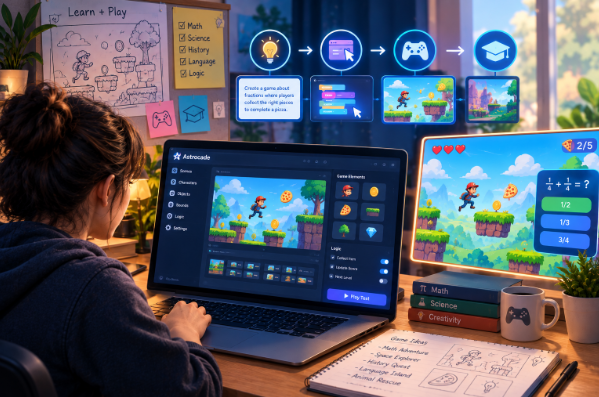

Educational games have a reputation problem. Too many of them feel like a worksheet wearing a game’s costume, technically interactive but obviously more interested in delivering a lesson than in being genuinely fun to play. The best educational games flip that priority, treating fun as the foundation and letting learning happen as a natural byproduct of engaging gameplay. No-code game makers are making it realistic for educators, hobbyists, and small creators to actually build games like that, without needing a technical background or a large development budget.
Why So Many Educational Games Fail to Be Fun
Lessons Get Prioritized Over Play
Many educational games start with the lesson and try to wrap a game around it afterward, which often results in gameplay that feels like an obligation rather than something a player wants to do. When the educational content clearly comes first and the fun is an afterthought, players notice, and engagement drops quickly.
Repetition Without Variation Becomes Tedious
Educational mechanics often rely on repeating the same type of question or task to reinforce learning, which can become monotonous fast if there’s no variation in how that repetition is presented. Players disengage when a game feels like doing the same drill over and over with a different skin on it each time.
What Makes an Educational Game Actually Fun
Start With the Game, Then Build the Learning Into It
The strongest educational games begin with a genuinely engaging core mechanic and find ways to weave educational content into that mechanic naturally, rather than starting with the content and trying to make it entertaining after the fact. A game that would still be fun even without its educational layer tends to succeed far more often than one that only exists to deliver a lesson.
Make Failure Feel Like Part of the Game, Not a Punishment
In good educational games, getting something wrong feels like a natural part of playing and trying again, rather than a harsh penalty that discourages further attempts. This keeps players experimenting and learning through repetition without the process feeling punitive.
Give Players a Reason to Care Beyond the Lesson
A strong hook, whether that’s competition, curiosity, humor, or a satisfying core loop, gives players a reason to keep playing that exists independently of the educational content itself. When players are motivated by the game rather than by obligation, the learning tends to stick better as a natural side effect.
How No-Code Tools Make Educational Game Design More Accessible
Educators Don’t Need to Learn to Code First
Historically, an educator or subject-matter expert with a great idea for a learning game had no realistic way to build it without partnering with a developer. No-code tools remove that barrier, letting someone who deeply understands the subject matter build a playable version of their idea directly.
Faster Iteration on What Actually Teaches Well
Educational effectiveness is hard to predict on paper and much easier to judge once real players are interacting with a mechanic. No-code tools let creators test and adjust how a concept is taught quickly, refining based on what actually helps players understand something rather than guessing in advance.
Testing Fun and Learning Separately
Because building is fast, creators can test whether a mechanic is fun on its own before layering in educational content, and then test whether that content integrates naturally afterward. This separation helps avoid the common trap of educational games where fun and learning were never properly balanced against each other in the first place.
Building an Educational Game With a No-Code Platform
Having a strong idea for an educational game is only useful if there’s a fast way to actually build and test it without a technical team.
A Platform Suited to This Kind of Creation
Astrocade is a good example of a no-code game maker that lets creators bring an educational concept to life quickly, without needing programming knowledge to test whether the core mechanic actually works before adding any learning content on top of it.
Seeing a Simple, Engaging Concept in Practice
The Journey Begins is a good example of a game built around a clear, approachable premise that players can understand quickly. This kind of straightforward, welcoming structure is exactly the foundation that educational content tends to layer onto well, since players aren’t fighting through confusing mechanics before they can even engage with what the game is trying to teach.
Common Mistakes When Designing Educational Games
Making the Educational Content Impossible to Skip or Ignore
Forcing players through rigid educational segments with no flexibility can feel more like a lecture than a game. Giving players some sense of control or pacing over how they engage with content tends to keep the experience feeling like play rather than instruction.
Overloading a Single Session With Too Many Concepts
Trying to teach too much within one game or one session can overwhelm players and dilute retention. Focusing on a smaller number of concepts, reinforced well through engaging repetition, tends to produce better learning outcomes than covering broad ground shallowly.
Neglecting Playtesting With the Actual Target Audience
An educational game that works well for adults testing it internally may not land the same way with the actual intended audience, especially when that audience is children or a specific age group with different attention spans and interests. Testing directly with the intended players is essential for catching this gap early.
A Practical Approach to Building Fun Educational Games
A reasonable process looks like this. Start by designing a core mechanic that would be fun even without any educational content attached, then look for natural ways to weave learning objectives into that mechanic rather than the other way around. Use a no-code platform to build and test the core loop quickly, confirming it’s engaging on its own before adding educational elements. Test with the actual intended audience early and often, paying close attention to whether they’re engaged by the game itself or simply tolerating it to get through required content.
Final Thoughts
The best educational games succeed because they’re genuinely fun first and educational as a natural result of that engagement, not the other way around. No-code game makers are giving educators, hobbyists, and small creators a realistic way to build games like this themselves, without needing a technical team to bring a strong idea to life.