Sportsbook screens use odds to show the price of an outcome and its potential return. Numbers such as 1.75, 2.20, or 4.50 are common decimal odds. They do not predict the future or guarantee a result. Learning how to interpret them helps a 9Wicket user compare markets, understand risk, and review a bet slip before confirming it.
Odds can change until a selection is accepted. The value shown on the final 9Wicket bet slip and the current settlement rules determine the wager.
How decimal odds calculate a potential return
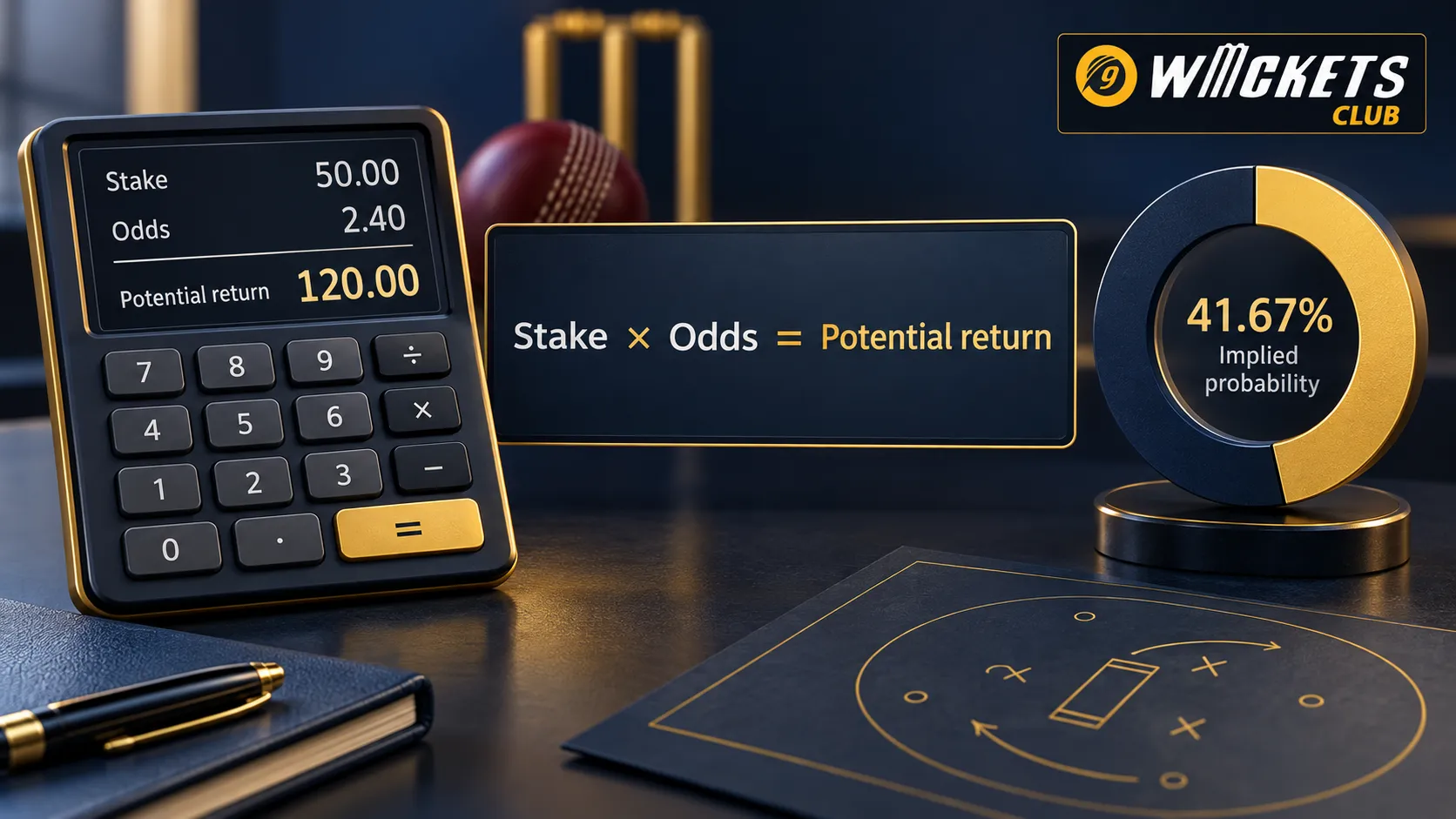
The basic formula is:
Potential total return = Stake × Decimal odds
A hypothetical ৳100 stake at 2.20 would display a potential total return of ৳220, including the original stake. The potential profit would be ৳120. This illustration assumes a normal winning settlement. A void selection, partial settlement, tax, or applicable fee can change the final amount.
Convert odds into implied probability
Decimal odds can be converted into an approximate implied probability:
Implied probability = 1 ÷ Decimal odds × 100
|
Decimal odds |
Approximate implied probability
|
|---|---|
|
1.50 |
66.7% |
|
2.00 |
50% |
|
2.50 |
40% |
|
4.00 |
25% |
Implied probability is a way to read the price, not an objective forecast. It may include a bookmaker margin and may react to new market information.
Understand bookmaker margin
If you calculate the implied probability of every outcome in a market and add them together, the total often exceeds 100%. The difference is sometimes called the overround or margin. Compare like-for-like markets because a three-way football market, a two-way cricket market, and an exchange-style market may be structured differently.
Why 9Wicket odds can move
Prices may change after a team announcement, injury, weather update, cricket toss, player withdrawal, or significant market activity. Live prices can react to the score, clock, possession, wickets, or required run rate. A falling price does not make the selection certain, and a rising price is not automatically good value.
For sport-specific context, compare the 9Wicket cricket betting guide, the football betting guide, and the basketball betting guide.
Read the complete market name
A price has meaning only when paired with a precise market. “Team A at 2.00” is incomplete without knowing whether it refers to match winner, first innings, a handicap, qualification, or regulation time. Check:
-
event and competition;
-
starting time and time zone;
-
market name and line;
-
whether overtime, extra time, or a super over counts;
-
player participation conditions;
-
abandonment and postponement rules.
Single bets and accumulators
A single contains one selection. An accumulator combines several selections, and all of them normally need to win. Multiplying the prices creates a larger displayed return, but every extra selection adds another failure point. Beginners may understand settlement more easily by following individual single selections first.
Review the final bet slip
Before confirming, read the event, market, selection, current odds, stake, and estimated return. Similarly named teams may belong to a youth, reserve, women’s, or esports competition. If an odds-change message appears, decide whether you accept the new price instead of allowing every change automatically.
A pending submission is not necessarily accepted. Check the account status before attempting the same action again.
A practical 9Wicket odds routine
-
Confirm the event and market definition.
-
Calculate the implied probability.
-
Review official team or player information.
-
Check settlement and abandonment rules.
-
Set the stake before opening the slip.
-
Review any price change.
-
Confirm that the selection was accepted.
Odds literacy does not remove uncertainty, but it makes sportsbook decisions easier to understand and document. Use the official 9Wicket interface, read the complete market, and ignore claims about fixed matches or guaranteed tips.
18+ only. Odds never guarantee a result. Do not borrow money, use essential funds, or chase losses.