

Most vapers can discuss flavours for an hour and their liquid’s actual contents for about ten seconds. The bottle in your pocket is a four-ingredient formulation whose every component — the base liquids, the nicotine chemistry, the flavourings, even the ratio printed in small type — shapes how your vape feels, wicks, hits and satisfies; and understanding it converts a wall of confusing labels into an open book. This guide is the ingredient-level tour: what PG and VG actually are and do, how nicotine salts differ from freebase at the chemistry level and why it matters to your throat, what flavourings are and aren’t, how UK regulation polices the whole recipe, and how to read any label in five seconds. It pairs naturally with technique guides on how to vape: they teach the inhale, this teaches what you’re inhaling — and vapers who know both stop buying wrong bottles forever.
The Four-Ingredient Truth
Strip the marketing and every mainstream UK e-liquid is the same short recipe: propylene glycol (PG) and vegetable glycerine (VG) as the carrier base making up the overwhelming bulk; food-grade flavourings at a few percent; and nicotine, from zero to the legal 20mg per millilitre. That’s the list. No tar — tar is a combustion product, and nothing combusts; no carbon monoxide, for the same reason; and none of the several thousand chemicals of cigarette smoke, whose absence is the entire arithmetic of harm reduction. What vapour adds beyond the recipe are the modest by-products of heating, which is why coil condition and sensible power matter and why regulation caps and tests what goes in the bottle. Four ingredients, each worth knowing personally — so take them in turn.
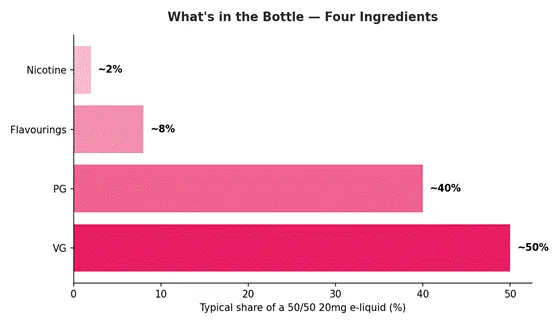
What’s actually in the bottle — the typical composition of a UK e-liquid.
PG: The Flavour Courier
Propylene glycol is a thin, colourless liquid with decades of history in food, medicine and inhalers, and in e-liquid it does three jobs: it carries flavour superbly (aromatics dissolve and travel best in PG, which is why flavour-forward liquids lean on it), it produces the throat hit — that light scratch on the inhale that ex-smokers half-need — and its thinness wicks easily into the small coils of MTL pod kits. Its trade-offs: PG makes less visible vapour, and it is mildly drying — the dry-mouth of a long session is largely PG doing its humectant thing, answered with water. A small minority of vapers find themselves PG-sensitive — persistent throat irritation beyond the adjustment period — and their fix is simply shifting toward higher-VG ratios. For everyone else, PG is the reason your liquid tastes like its label and lands like a cigarette used to.
VG: The Cloud and the Silk
Vegetable glycerine is PG’s thick, faintly sweet sibling — plant-derived, equally long-established in food and cosmetics — and it contributes the body: dense visible vapour, a smooth soft inhale, and a gentle background sweetness that rounds flavours off. Its trade-offs mirror PG’s exactly: VG carries flavour less crisply, delivers little throat hit, and its syrupy viscosity wicks slowly — which is why thick high-VG liquid in a small tight pod starves the coil into burnt hits, and why the ratio on the label is really a hardware-compatibility spec. High-VG blends belong in the big airy sub-ohm hardware built to feed and vaporise them; balanced blends belong in pods. Neither base is ‘better’; they are two ends of a dial, and the ratio sets where your liquid sits on it.
The Ratio: A Compatibility Spec in Disguise
Which brings us to the small print that beginners skip and veterans read first: the PG/VG ratio. Around 50/50 — the standard for pod kits and nic salts — balances flavour, throat hit and easy wicking for small coils; 70VG and beyond is cloud territory for sub-ohm tanks; the occasional high-PG blend maximises flavour and hit for the tightest MTL setups. The practical rule: match the bottle to the hardware’s guidance, and when in doubt on any pod system, 50/50. The symptoms of mismatch are diagnostic once you know them — high-VG in a pod gives dry burnt notes as the wick starves; and a liquid that gurgles and floods a big airy coil is usually too thin for it. One label line, five seconds of reading, and an entire category of bad vaping days is deleted.
Nicotine Two Ways: Freebase and Salts
Now the active ingredient, which comes in two chemical forms with genuinely different behaviour. Freebase nicotine — the original — is nicotine in its pure basic form: effective, but increasingly harsh on the throat as concentration rises, which historically capped comfortable strengths and left heavy smokers under-served. Nicotine salts solve exactly that: by combining nicotine with an acid (typically benzoic), the resulting formulation sits closer to the chemistry of nicotine in tobacco leaf — dramatically smoother to inhale at high strengths, and faster-absorbing, delivering the quick satisfaction curve that makes a 20mg salt pod genuinely replace a cigarette. The practical mapping writes itself: salts for MTL pod kits, higher strengths and switching smokers — the modern default; freebase for the low-strength, high-volume cloud styles where its sharper edge suits the dilution. It is the single most consequential line on the label after strength itself, and most bottles now state it plainly.
Strength, Honestly Read
The number on the front — 20mg, 10mg, 0mg, sometimes written as 2%, 1%, 0% — means milligrams of nicotine per millilitre of liquid, and the UK caps it at 20mg/2% with no legal exceptions. Two reading skills complete the picture. First, strength and form interact: 20mg as salts inhales smoother than a fraction of that as freebase, so the number alone never predicts harshness — form does. Second, strength is a dosing decision, not a machismo scale or a caution scale: matched to your actual habit it produces calm, bounded sessions; mismatched low it produces the compensatory chain-vaping that consumes more liquid and satisfies less. Anything labelled above 20mg in a UK context is announcing itself as non-compliant or counterfeit, which segues to the recipe’s invisible fifth ingredient: regulation.
The Invisible Ingredient: UK Regulation
What separates a UK retail e-liquid from a mystery liquid is a compliance regime most vapers never see working. Under the UK’s TPD-derived rules, nicotine liquids are capped at 20mg strength and 10ml bottle sizes, notified to the MHRA with their full ingredient lists, tested for emissions, banned from containing a list of substances — including, notably, diacetyl, the buttery flavouring behind the ‘popcorn lung’ scare, prohibited in UK e-liquid for years — and wrapped in childproof packaging with mandated warnings. The label signature this produces is your five-second authenticity check: nicotine warning covering the pack face, strength at or below 20mg, ingredients listed, UK responsible-party address present. Liquids that skip the regime — imports at impossible strengths, marketplace bargains, anything unlabelled — have opted out of every safeguard above, which is precisely why the buying-genuine habit carries so much of vaping’s real-world safety. Established UK specialists do this diligence wholesale; pink vape stocks notified, compliant liquids and prefilled formats across the strength range, which reduces the entire regulatory chapter to shopping in the right place.
Reading Any Label in Five Seconds
Assemble the tour into the practical skill: pick up any bottle or pod pack and read four things in order. Strength — matched to your habit, at or below 20mg. Form — salts for pods and switching, freebase for low-strength cloud setups. Ratio — matched to your hardware, 50/50 as the pod default. Compliance signature — warning, ingredients, UK address, childproof cap. Four glances; and behind them, you now know, sits the whole story: PG carrying the flavour and the hit, VG carrying the cloud and the silk, food-grade flavourings at a few percent, nicotine in its chosen chemistry, and a testing-and-notification regime standing over the lot. The vaper who reads this way buys right the first time, diagnoses mismatches by symptom, and never again mistakes marketing for information.
E-Liquid FAQs
The label-reading questions that remain. Why does my liquid have no colour, or too much? Clear to pale gold is normal; darkening over months is oxidation — a freshness signal, not a hazard, in genuine stock. Is the sweetness an added sugar? No — perceived sweetness comes from flavourings and VG’s natural character; actual sugars would caramelise instantly on coils. What is ‘ice’ or ‘koolada’ on labels? Cooling agents that create the icy exhale without mint flavour — a trigeminal effect, not a temperature one. Are there allergens to check for? PG sensitivity is the notable one (persistent irritation beyond week one — switch toward VG); those with specific flavouring allergies should read the notified ingredient lists that compliance makes available. Why do two 20mg liquids feel different? Form (salt versus freebase), ratio, and flavour profile all modulate perceived strength — the number is dose, not experience. Do nicotine-free liquids need the same care? Same storage and child-safety respect — flavourings and glycols still don’t belong in small mouths — minus the toxicity urgency. And can I trust ‘organic’ or ‘natural’ labels? Treat them as marketing; the trust-bearing text is the compliance signature, which no adjective replaces.
The Bottom Line
E-liquid literacy is a small superpower disproportionate to its effort: one short recipe, two base liquids on a dial, two nicotine chemistries, one ratio spec and one compliance signature, and the entire shop wall becomes legible. It sharpens every other vaping skill — technique lands better on matched liquid, maintenance makes sense when you know what gunks coils, step-downs run smoother when strength and form are understood — and it is the final defence against the counterfeit fringe where the category’s genuine risks pool. Read your labels, match your recipe to your hardware and your habit, buy notified and genuine, and the liquid in your pocket becomes exactly what it should be: a known quantity. Adults 18 and over, existing smokers and vapers only, as always — and for everyone else, the most elegant formulation remains the empty bottle never bought.
